Solutions By Materials:

Aluminum and aluminum alloys

Metallographic Preparation Solutions by Material

Use this guide for advice on where to start when performing metallographic preparation and analysis on aluminum and aluminum alloys. Included are tips for achieving the best results for your metallographic application.

Things to consider when working with aluminum and aluminum alloys

Things to consider when working with aluminum and aluminum alloys
Aluminum is a soft, ductile metal. Improper prep-induced damage is a common preparation problem in the purer compositions. Extra care must be taken to prevent deformation during cutting and mounting.

Depending on the composition, processing and thermal treatment, the preparation method can change. As an example, with pure aluminum, the chances of abrasive particles embedding are higher than with other aluminum materials. A polishing method can be adjusted for this by utilizing paste instead of suspension.

Aluminum Cutting Tips

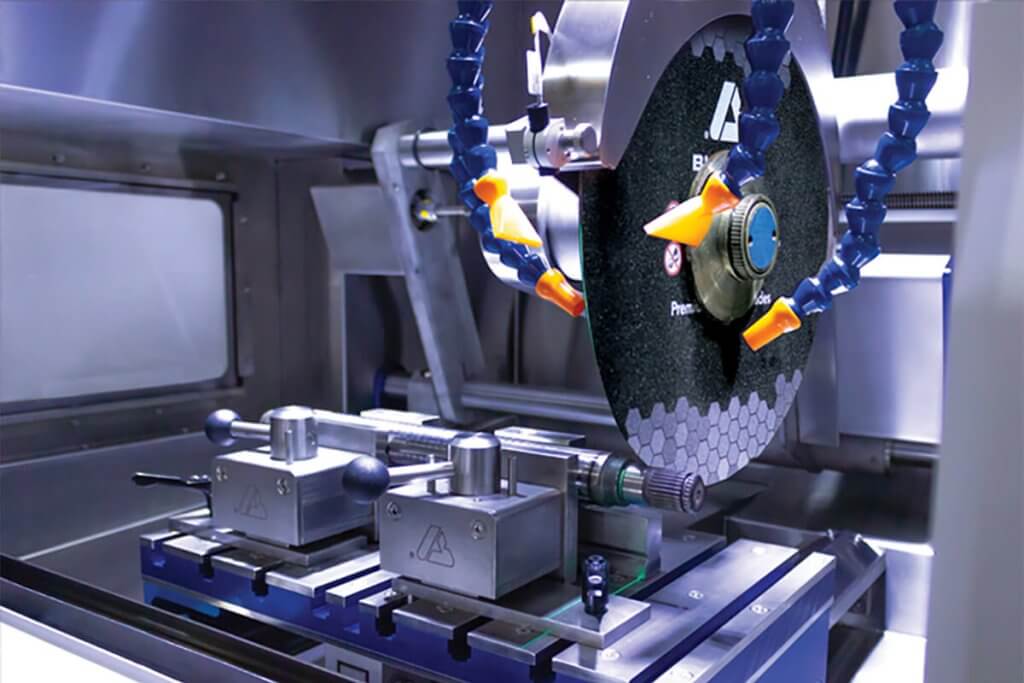
Abrasive Cutting Tips for Aluminum

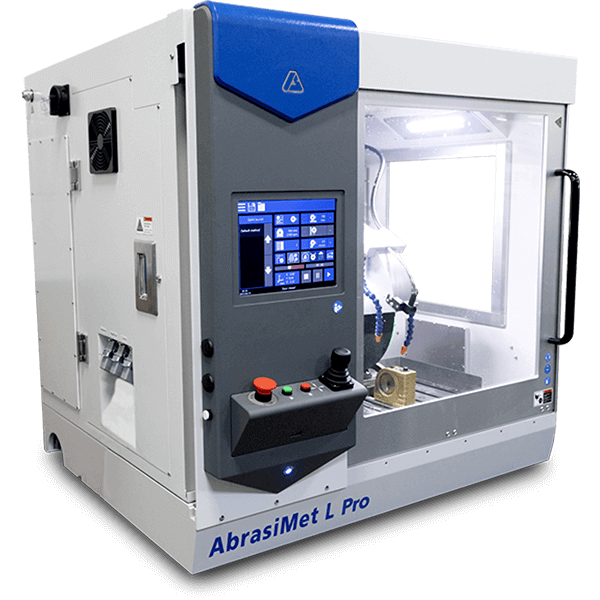
All sectioning should be performed wet, with an ample flow of coolant directed into the cut. Wet cutting will produce a smoother surface finish than a dry cut. Using coolant will also guard against surface damage caused by overheating and mechanical strains. Reducing damage while sectioning is important. Mechanical damage, such as fractures can penetrate deep into the structure and make later preparation steps longer. There are two main types of cutting tools offered: Abrasive and Precision.

Abrasive Cutting Tips

Blades for Abrasive Cutters
Abrasive blades have different bond strengths and are recommended based on the efficiency of their bond strength and abrasive type with different materials. Choosing an incorrect blade can lead to improper wear rate and possibly alter the existing microstructure. An abrasive blade is entirely made up of abrasive bound together by a resin. When used, blades get smaller in size until they can no longer cut. A new blade can then be put on the sectioning piece of equipment to make additional cuts.

The size of the abrasive blade also affects cutting parameters. Larger, thicker blades remove more material but also generate more heat than a thinner blade. To reduce the heat produced by blades the feed rates should be lowered.
Recommended Abrasive blade for Aluminum
10in (254mm) 12in (305 mm) 14in (356mm) 16in (406mm)
102512P 0.06in [1.5mm] 103012P 0.079in [2mm] 103512P 0.1 [2.5mm] 10-31650-010 0.125in [3mm]

Precision Cutting Tips

Precision Cutting Tips for Aluminum

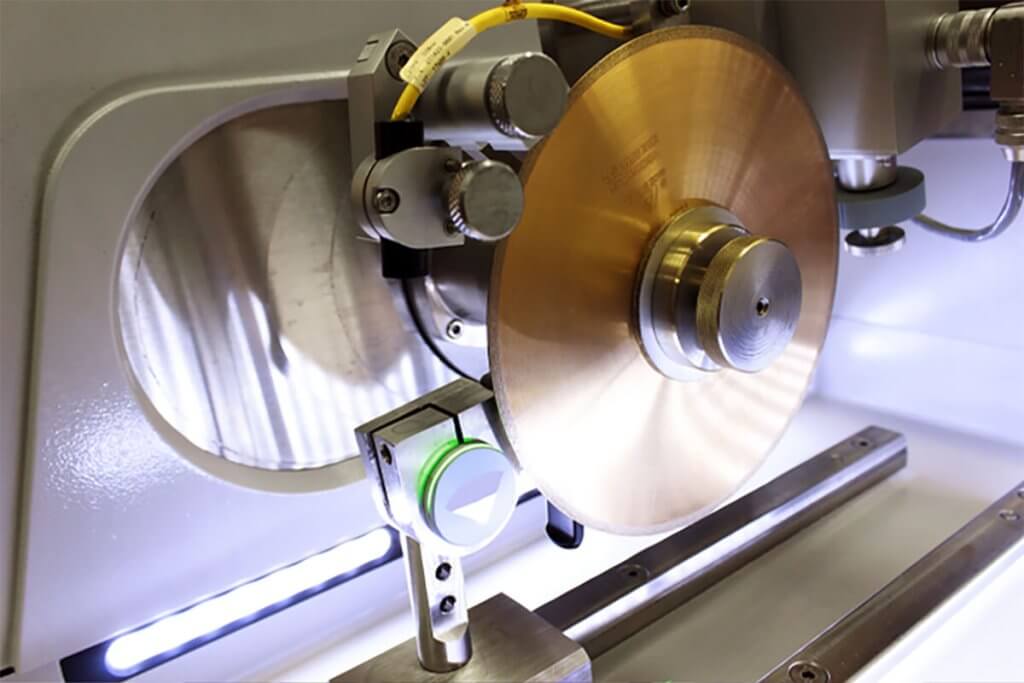
Precision cutters are used in metallographic preparation of aluminum when cutting samples that are small or delicate. Precision blades don’t break down as they are being used. On the outer edge of the blade there is a section where abrasive has been bonded with metal alloy and if taken care of one wafering blade can outlast a box of abrasive blades. Wafering blades can be used with aluminum for more difficult cuts including making a precise cut close to a feature of interest, or when it is critical to reduce the width of a cut (kerf loss).

Additional benefits of using a precision cutter are a lower load is applied and consequently, less heat is generated, reducing the amount of damage.

Abrasive blades are also made for precision cutters. They can be used in instances where breaking blades is high. This could be if you have a difficult to clamp part, have a part that might shift during sectioning or you have more variability in the process (ex: multiple operators).

Recommended Precision blades for Aluminum
5in (127mm) 7in (178mm) 8in (203mm) Dressing Stick
11-4215 0.020in [0.5mm] 11-4237 0.025in [0.6mm] 11-4238 0.035in [0.9mm] 11-1190
11-2490

Aluminum Mounting Tips

Composite Mounting Tips
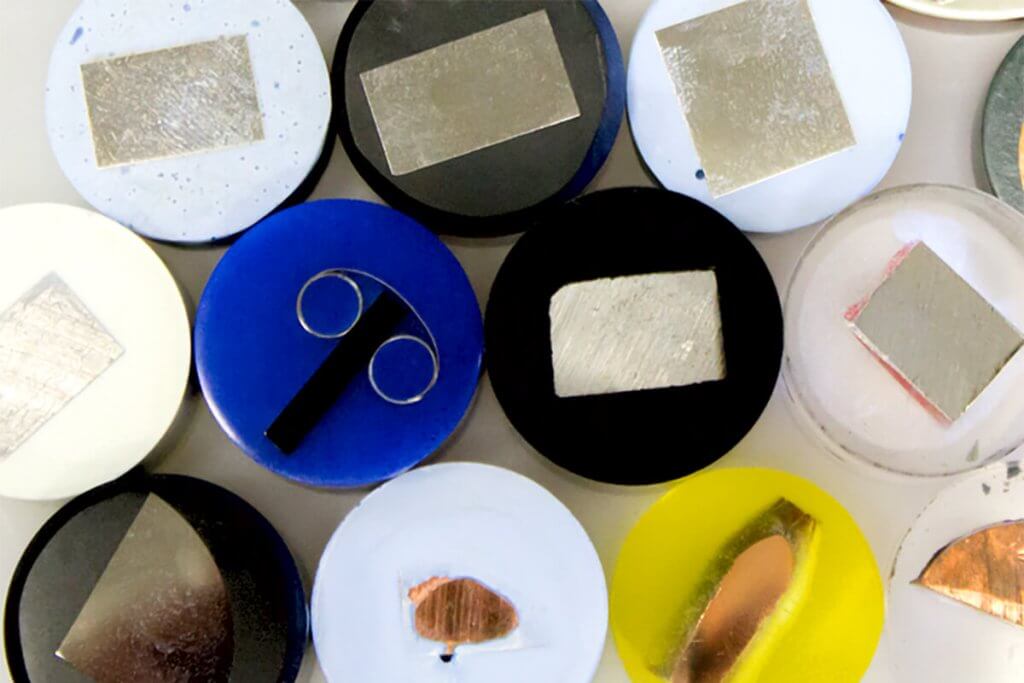
Mounting metallographic samples can allow automation and increase ease of handling during the subsequent steps of metallographic preparation and examination. Intricately shaped samples can be mounted to create uniform shapes allowing automation of the sample preparation process.

Mounting samples also protects and preserves edges or surface defects during metallographic preparation. The method of mounting should in no way alter the microstructure of the specimen. Pressure and heat are the most common sources of injurious effects. Temperatures around 350oF and pressures around 4000 PSI are common for hot compression mounting.

Sample geometry and properties can determine the appropriate method for mounting aluminum samples. Use castable mounting when samples are thin or deformed easily. Samples such as these tend to be sensitive to high pressures. If samples are not sensitive to pressure hot compression mounting can be a time and money saver.
For general use PhenoCure® is a sound choice. EpoMet® or Diallyl Phthalate exhibit better edge retention relative to PhenoCure and would be good options if this criterion is a priority. In the event that a transparent mold is of interest, consider TransOptic. Being a thermoplastic, TransOptic when heated and held at temperatures between 105-115oC for around 20 minutes softens allowing sample removal.

For electron microscopy, ProbeMet is a suitable copper-based conductive media. If copper content is of interest in the sample KonductoMet® is a carbon-filled conductive alternative to ProbeMet.
Composite Hot Compression Mounting
Thermal Spray Coating Mounting Tips

Careful selection can ensure media meets mounting needs regarding timing, viscosity, temperature, and shrinkage. Acrylic systems can increase throughput with quick curing times between 5 -30 minutes. Though quicker in curing, sample adhesion and viscosity of acrylics can sometimes be lacking especially with more intricate shapes. This is where epoxy systems can help. With longer working times, mixed epoxy can be used with a vacuum system to help penetration levels in intricate geometries. Our epoxy systems also offer lower peak exothermic systems. Additional information can be found on our mounting page.

Aluminum Grinding & Polishing Tips for All Methods

Aluminum Grinding & Polishing Tips for all Methods

Deformation in aluminum and aluminum alloy samples tends to be deeper than in other material types. To help mitigate, swap out SiC papers after 1-minute cycles and keep sequential steps close in abrasive size. Keeping the abrasive sharp will help to reduce the amount of damage created from grinding.

Abrasive particles embedding into aluminum is another possible preparation artifact. If you encounter this problem switch to diamond paste. If using silicon carbide paper then scentless candle wax or paraffin wax can be applied to the paper to help silicon carbide particles from embedding in samples.

Soft aluminum such as o-temper alloys and pure aluminum are susceptible to deformation and scratches, to address this use a brief vibratory polishing step with MasterMet®.

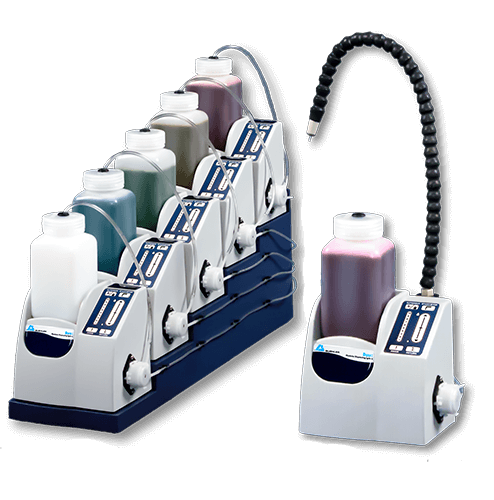
Using Buehler’s Burst Dispensing System can conserve diamond suspension and improve consistency. This system can simultaneously dispense extender and diamond suspension.

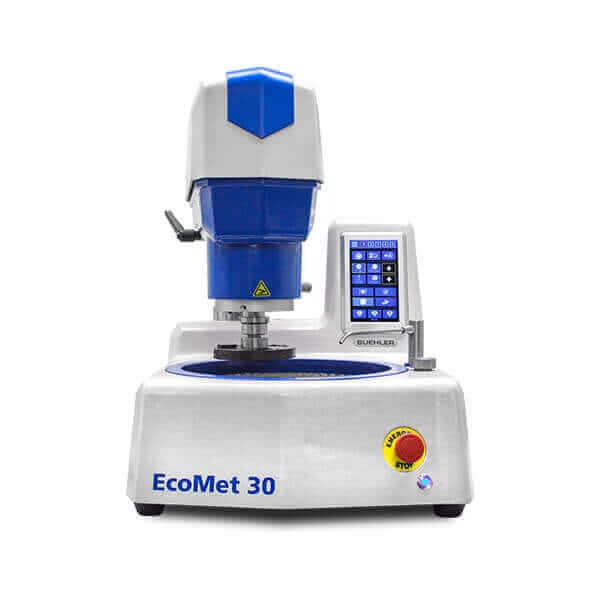
The ideal rate for the Burst dispensing system changes with the size of the platen and the polishing cloth that is being used. As a general guideline, for a platen size of 8” a burst setting of 3 is a good starting point, for sizes of 10″ and 12″ set the burst system to 4 and adjust as needed. Some experimentation may be required to determine optimal settings to ensure sufficient abrasive and wetting of the cloth. Burst dispensers are also capable of dispensing extenders simultaneously with diamond suspensions if desired.

Burst Dispensing System

Loads listed in grinding and polishing methods are recommendations for one 1.25″ mounted specimen. If using central force during preparation the force listed should be multiplied by the number of samples being polished. For different sample sizes, use our load conversion calculator to determine the correct load for your application.

Procedure for Grinding and Polishing Aluminum (General)
Surface Loads [N] Base Speed [rpm] Relative Rotation Time
CarbiMet® 320 grit 5 [22] 300 rpm Relative Rotation Until Plane
UltraPad with 9um MetaDi® Supreme Diamond 5 [22] 150 rpm Relative Rotation 5:00
TriDent with 3um MetaDi Supreme Diamond 5 [22] 150 rpm Relative Rotation 4:00
ChemoMet® with MasterMet® Colloidal Silica 5 [22] 150 rpm Relative Rotation 1:30
Platen = Platen Specimen Holder = Specimen Holder *Plus MetaDi Fluid Extender as desired
Procedure for Grinding and Polishing Soft Aluminum including Super Pure Aluminum and Commercially Pure Aluminum
Surface Loads [N] Base Speed [rpm] Relative Rotation Time
CarbiMet® 320 grit 5 [22] 300 rpm Relative Rotation Until Plane
TexMet® C with 9um MetaDi Supreme Diamond 5 [22] 150 rpm Relative Rotation 5:00
TexMet C with 3um MetaDi Diamond Paste with extender 5 [22] 150 rpm Relative Rotation 4:00
TexMet C with 1um MetaDi Diamond Paste with extender 5 [22] 150 rpm Relative Rotation 2:00
ChemoMet with MasterMet Colloidal Silica 5 [22] 150 rpm Relative Rotation 1:30
Platen = Platen Specimen Holder = Specimen Holder *Plus MetaDi Fluid Extender as desired

Aluminum Etching Tips

Thermal Spray Coating Etching Tips

Aluminum may contain discrete intermetallic particles that may be attacked by etchants before the matrix. If you encounter this problem, energy-dispersive analysis can be used for phase identification in place of etching.

In the table below methods for Aluminum can be found.

Table 20.1: Light Metals - Aluminum Alloys
Composition Comments
95mℓ water 2.5mℓ HNO3 1.5mℓ HCl 1.0mℓ HF Keller’s reagent, very popular general purpose reagent for Al and Al alloys, except high-Si alloys. Immerse sample 10-20 seconds, wash in warm water. Can follow with a dip in conc. HNO3. Outlines all common constituents, reveals grain structure in certain alloys when used by immersion.
90-100mℓ water 0.1-10mℓ HF General purpose reagent. Attacks FeAl3, other constituents outlined. The 0.5% concentrations of HF is very popular.
84mℓ water 15.5mℓ HNO3 0.5mℓ HF 3g CrO3 Graff and Sargent’s etchant, for grain sizes of 2XXX, 3XXX, 6XXX, and 7XXX wrought alloys. Immerse specimen 20-60 seconds with mild agitation.
1.8% fluoboric acid in water Barker’s anodizing method for grain structure. Use 0.5-1.5 A/in2, 30-45 V DC. For most alloys and tempers, 20 seconds at 1 A/in2 and 30 V DC at 68° [20°C] is sufficient. Stirring not needed. Rinse in warm water and dry. Use polarized light; sensitive tint helpful.
4g KMnO4 1g NaOH 100mℓ water Weck's tint etchant for Al and Al alloys, a very popular etchant for general purpose, especially good for reveal the grain of wrought alloys. Immerse sample for 15-20 seconds and gently wave the sample until the surface is colored.

Aluminum Imaging Tips

Thermal Spray Coating Imaging Tips

Depending on the alloy and application the goal of analysis can differ. Some common goals of the analysis are porosity, contaminant levels, grain structure, phase percent, and dimensional measurements. Dimensional measurements can be taken and saved using one of the lower levels of our OmniMet® software. For other analysis and exporting needs more advanced versions of the OmniMet software maybe required.

Aluminum Hardness Testing Tips

Reference Materials for Hardness Testing
  ASTM ISO
Brinell E10 6506
Rockwell E18 6508
Vickers E92,E384 6507
Knoop E384 4545
Instrumented E2546 14577
Conversions E140 18265
ASM Handbook Volume 8: Mechanical Testing and Evaluation Hardness Testing Section

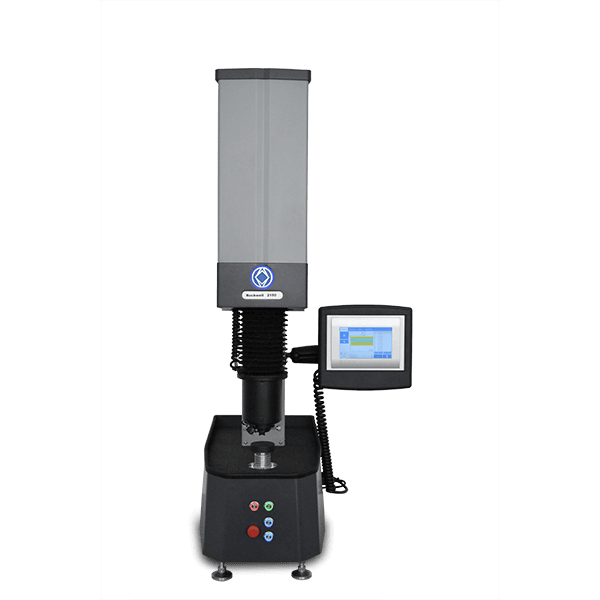
At Buehler, the equipment offered is made to perform at least one of the following scales: Brinell, Rockwell, Vickers and Knoop. If utilizing a scale previously mentioned there are standards for the method of testing. Standards such as the ones listed in the table are good places to reference the proper method of testing for the scales. Requirements for equipment, samples, testing methods and more are described within that can help determine the correct scale.

Equipment capabilities vary in levels of automation and documentation. Some pieces are integrated with hardness testing software. Software such as Buehler’s DiaMet can assist with testing parts more efficiently, accuracy and result documentation. This can be especially helpful when a large amount of indents must be done on one part.

Related Products

Abrasive Cutter

Castable Mounting Systems

Semi-Auto Grinder Polisher

Rockwell Hardness Tester

Dr. Mike Keeble

Find Your Solutions

Full Lab
Metallography Solutions
Looking for more information from us? Browse through our Solutions section to view technical articles, find recommended processing methods, look at industry solutions, and more.
Need Additional Help?

Do you want to improve your process? Reach out for one-on-one help from our applications experts.

Contact Buehler Lab

Contact Lab Team

Contact Buehler

Contact Customer Care

Quick Links

Quickly access important info or visit our E-Shop

Buehler Literature
Product Catalog

View all Products in the Buehler Product Catalog
methods by material
Methods by Material

Select a method by material
SDS Search
SDS

Search Buehler's Safety Data Sheets

Buehler Literature Search
Product Literature

Browse and search Buehler's product literature
Optimize Your Sectioning
Buehler an ITW Company
Buehler Products