United States | EN
 Canada | EN
 United Kingdom | EN
 German | DE
 France | FR
 Mexico | ES
 Japan | JA
 China | ZH
Vibratory Polishing Machines
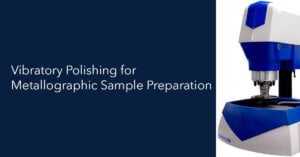
Vibratory polishing is an advanced metallographic finishing technique that produces a deformation-free surface with minimal operator effort. It is widely used for applications requiring high-quality surface finishes, particularly where preservation of microstructural integrity is critical. It can be used on any material or combination of materials but is particularly effective for preparing sensitive, soft, or ductile materials that are prone to deformation during conventional mechanical polishing.
The VibroMet 3 vibratory polisher operates by generating high-frequency, variable-amplitude vibrations with nearly 100% horizontal motion and negligible vertical displacement. This motion enables stress-free polishing, preserving delicate surface features. After processing periods ranging from several minutes to a few hours—typically without operator intervention—samples achieve a highly refined surface finish with excellent edge retention.
Abrasives and Polishing Media
Vibratory polishing is typically performed using Oxide-based suspensions such as colloidal silica or alumina (e.g., MasterMet, MasterPrep, MicroPolish). A commonly used solution is MasterMet 2, a 0.02 µm colloidal silica suspension formulated with additives to resist drying and crystallization.
Applications in High-Resolution Analysis
Vibratory polishing is especially beneficial for high-precision characterization methods, including:
- Electron Backscatter Diffraction (EBSD)
- Nano-indentation hardness testing
These techniques are extremely sensitive to surface deformation and flatness, even at levels not visible through standard metallographic imaging. Vibratory polishing significantly enhances surface quality, improving diffraction pattern quality and measurement accuracy.
Process Requirements and Best Practices
For optimal results, specimens must be properly pre-prepared using standard grinding and mechanical polishing techniques, including a high-quality final polish. Vibratory polishing should be viewed as a final refinement step rather than a substitute for earlier preparation stages.
Recommended practices include:
- Use polishing suspensions in the range of 1 µm to 0.02 µm, often the same suspension used in the final mechanical polishing step
- Avoid chemical additives (e.g., hydrogen peroxide or etchants), as they are generally unnecessary
- Ensure uniform dispersion of the polishing suspension across the cloth
- Maintain adequate moisture, particularly with oxide suspensions, to prevent crystallization
Polishing Cloth Selection
Flocked or napped polishing cloths are recommended, such as:
These cloths facilitate smooth specimen movement and promote uniform surface finishing.
Sample Weight and Polishing Time
Sample pressure is applied through the sample’s own weight or by the addition of extra weights. For effective results:
- Samples should be sufficiently rigid
- A minimum total mass of approximately 4 N (0.4 kg) is recommended
Insufficient weight may lead to surface corrosion or tarnishing during processing.
Polishing time varies depending on material properties and process parameters, particularly vibration amplitude. In many cases, noticeable improvements can be achieved in under 30 minutes. For unfamiliar materials, polishing duration should be determined empirically.
Vibratory Polishing for Metallographic Sample Preparation FAQs
On This Page
Need Help with your Sample Preparation?
Our application specialists can help you develop the right grinding and polishing process for your material and analysis needs.
Explore the Metallographic Grinding and Polishing Guide Series
Metallographic Grinding and Polishing Guide
Mechanical preparation is the most widely used method in metallographic sample preparation. This approach involves the systematic refinement of the sample surface through material removal, with the primary objective of eliminating deformation and damage introduced during prior processing steps.
Manual vs. Semi-Automatic Metallographic Grinding and Polishing
Compare manual and semi-automatic grinding and polishing methods, including specimen manipulation, central force, and individual force preparation.