Home » Sectioning

MetallographyU
Resource Center

Educational resources for materials preparation, testing, analysis, and laboratory best practices.

Stay informed with expert tips, how-to-guides, and industry insights to help you achieve accurate, reliable analysis.

Featured Post

Metallographic Grinding and Polishing Guide

Learn the fundamentals of metallographic grinding and polishing, including mechanical preparation methods, grinding abrasives, polishing processes, consumable selection, surface preparation, and common polishing challenges.
Grinding and Polishing Guide
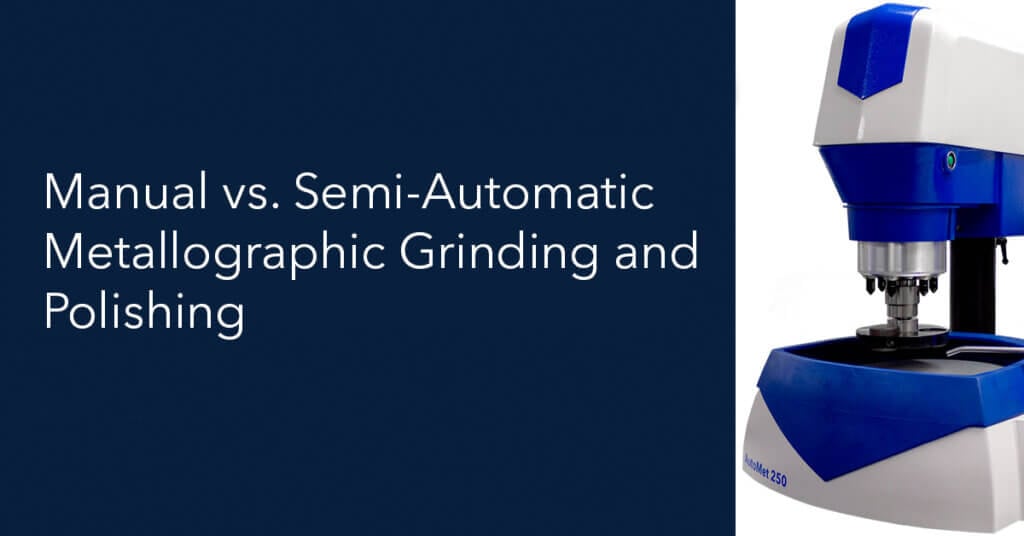
Manual vs Semi Automatic Metallographic Grinding and Polishing

Manual vs. Semi-Automatic Metallographic Grinding and Polishing

Metallography Grinding and Polishing Machines Metallographic grinding and polishing machines are available in manual and semi-automatic configurations. This guide compares manual vs. semi-automatic grinding and polishing methods, including specimen manipulation, central force, and individual force preparation. Manual Metallographic Grinding and Polishing Machines Manual grinding is the process of holding the

Read More »
Magnesium Metallographic Specimen Preparation and Testing

Magnesium Metallographic Specimen Preparation and Testing

Preparation of magnesium and its alloys is rather difficult due to the low matrix hardness and the higher hardness of precipitate phases that lead to relief problems, and from the reactivity of the metal. Mechanical twinning may result during cutting, grinding, or handling if pressures are excessive. Final polishing and

Read More »
Image Analysis for Hardness Testing

Image Analysis for Hardness Testing

Hardness testing is a fundamental characteristic in analyzing component properties, and, as an important materials testing tool, this critical parameter can performed and measured by a multitude of methods and techniques. While some hardness test types such the Rockwell test will yield fast, single process results based on indentation depth,

Read More »
Advanced Techniques for Hardness Testing

Advanced Techniques for Hardness Testing

Materials testing, including hardness testing, is a fundamental but useful element in analyzing component properties, and can be accomplished by a multitude of methods and techniques. Determining the hardness value can provide valuable insight to the performance, durability, strength, flexibility, and capabilities of a variety of material types from raw

Read More »
Gage Repeatability and Reproducibility

Gage Repeatability and Reproducibility

What is Gage Repeatability & Reproducibility (GR&R)? Gage Repeatability & Reproducibility, commonly known as a GR&R, is a statistical method used in process control (SPC) to measure the precision and variation present in a measuring device and the subsequent effectiveness of the instrument to be used as a measuring tool.

Read More »
Non-Destructive Hardness Testing

Non-Destructive Hardness Testing

Nondestructive testing (NDT) or Nondestructive evaluation (NDE) is a method of materials testing to assess the characteristics of a component without altering or destroying it. NDT is important in the materials testing industry where quick, dependable information on finished or raw material is needed. This may occur during the production

Read More »
Optimize Your Sectioning
Buehler an ITW Company
Buehler Products